
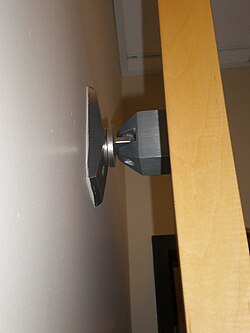
Does every held-open door need to have a smoke detector installed to close it? As always, it depends. The type of facility, the door’s location, the purpose of the door and what existing building controls are in place all play a role in whether it must be controlled by the fire alarm system. In this article, we’ll cover held-open door requirements that are part of smoke barriers or partitions.
Smoke Border vs. Smoke Partion
It’s important to know if the door is part of a barrier or partition of some type. Smoke borders are intended to stop the spread of fire, so floor to deck construction methods that must maintain a 1 hour fire rating are used. Any doors in a smoke border must be have a minimum 20 minute fire resistance rating, along with proper gasketing to resist the passage of smoke. They are most commonly used in defend-in-place occupancies that require compartmentalization. Smoke partitions don’t require a fire rating. They resist the passage of smoke, don’t require a fire rating and can end at the ceiling. They are most commonly required in egress corridors.
Held-Open Smoke Door Requirements
- IBC Section 710.5.2.3 requires doors in smoke partitions to be self- or automatic-closing by smoke detection IAC Sec. 716.2.6.6. Egress corridors usually have smoke barrier/partition requirements, so held open doors on egress corridors usually need to close to maintain that border’s integrity. If that’s the case, unless the corridor has complete smoke detector coverage, at least 1 detector mounted within 5′ of the door will be required, depending on ceiling heights on both sides of the door.
- NFPA 101 Chapter 8.4.3.5 also requires doors in smoke partitions to be self- or automatic-closing by smoke detection IAC Ch. 7.2.1.8. Chapter 8.5.4.4 requires doors in smoke barriers to also be self- or automatic closing doors.
- NFPA 72 Chapter 17.7.6 addresses smoke detection for the control of smoke spread, AKA smoke control. Specifically, Ch. 17.6.6 covers smoke detectors for door release, but it’s only in reference to smoke door release. These are doors that are installed for and intended to prevent the spread of smoke or complete a smoke partition. If a door isn’t located on a barrier/partition, this doesn’t apply.
- NFPA 72 Chapter 17.4.8 states “If the intent is to initiate action when fire/smoke threatens a specific object or space, the detector shall be permitted to be installed in close proximity to that object or space.” This is used more for high ceiling spaces that require smoke detection on their own (transformer rooms, atrium elevator lobbies, FACP, etc.).
- NFPA 105 (Standard for Smoke Door Assemblies) Chapter 4.5.1-3 states:
- 1. Smoke doors shall be self- or automatic closing IAC NFPA 80 (Standard for Fire Door Assemblies)
- 2. Automatic closing smoke door assemblies shall be activated by smoke detection installed IAC with NFPA 72
- 3. Devices for the release of smoke doors shall be permitted to be part of an overall system, such as a fire alarm or an automatic extinguishing system, that shall release the door and shall be installed and tested IAC with NFPA 72. This allows you to close the smoke door on general alarm.
In summary, code only requires smoke detection at a held open door that is:
- A part of a fire barrier/partition
- A part of a smoke barrier/partition
- Intended to control the spread of smoke control
- Protecting a specific space or piece of equipment
Use Affiliated Fire Systems expertise and Gamewell-FCI equipment to your advantage. We have 20 technicians average 15 years of experience between them, so you get efficient, accurate results the first time. Contact us today!
Gene Rowe, SET Affiliated Fire Systems, Inc. Downers Grove, IL 630.434.7900, info@affiliatedinc.com
 About Gene Rowe



Send us a Comment