
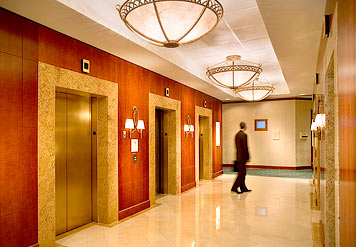
 What is elevator recall? When is it required? When should it be integrated with a fire alarm system? How is that accomplished? These are a few of the many questions both elevator and electrical contractors have when elevator work is performed. With the constantly changing technologies and capabilities of elevator control and fire alarm systems, questions like these mandate close coordination between contractors. This article will explain what elevator recall is (also referred to as firefighter emergency operations) and when it is required. It will also cover the integration of the fire alarm system with elevator firefighter emergency operations.
Per ASME A17.1 section 2.27.3, Firefighter emergency operations (FEO) are required in all automatic elevators with a rise of over 80″. If the facility has or is required to have a fire alarm system, then the elevator recall initiating devices are part of that system. This system has the added responsibility of notifying the occupants and the fire department of alarm conditions. If a reporting fire alarm system is not required, the elevator recall initiating devices can be part of a stand alone fire alarm system whose sole purpose is to initiate an FEO sequence. Except for activating an internal sounder, this system, which is to be plainly marked “Elevator Recall Control and Supervisory Panel”, does not notify occupants when activated, nor does it notify the fire department. However, it is located in a public space, generally near a security desk or the elevator lobby of the building’s main egress floor.
FEO activation is mainly addressed by ASME A17.1, ASME A17.3, NFPA 13, NFPA 70, NFPA 72 and NFPA 101. Locally, add in State of Illinois Public Act 096-0054, the Chicago Building Code, the Chicago Conveyance Code and enforcement by both the fire department and the local elevator inspection department to get a picture of how complicated it can get. Each of the codes address a slice of the pie, so there isn’t one location that one can look to for application guidance. We’ve consolidated the FEO requirements from these various regulations to help you understand what’s required, so let’s take a look.
First, let’s define what FEO is and how it’s activated. The FEO involves several phases of action, but essentially, it removes control and accessibility of the elevator cabs from the public and gives it to the firefighters. By giving firefighters total control of a facility’s elevators, they have an additional tool to fight the fire. In a high rise situation, this tool is critically important. A second, equally important result is the consideration for public safety. By removing public access to elevators, the possibility of injury or death due to getting trapped in a non-operational cab or actually being delivered to the involved floor is removed.
The sequence of events that removes the elevators from public use is collectively referred to as the FEO, but it’s also known as elevator recall, as the cabs are automatically recalled to a facility’s predetermined floor of egress. This predetermination is made by the local authority having jurisdiction (AHJ), usually the local fire department. Two floors of egress are determined: the Designated, or Primary Level and the Alternate Level. In the vast majority of cases, the Primary Level is the facility’s main entrance floor. If verification of the primary floor is needed, the elevator annunciator panel, fire alarm annunciator panel, firefighter’s communication center and controls to other building systems, such as fan, damper and stairwell door unlocking controls are located on the Primary Level as well. The Alternate Level is a secondary floor of egress should the Primary Level become unsafe for egress.
The first sequence of events in the FEO is conveniently referred to as Phase One operations. In Phase One, the cabs are automatically recalled to a facility’s predetermined floor of egress. Fire alarm system smoke detectors that are programmed to activate Phase One are located in the elevator lobbies, elevator hoistway and elevator machine room. If smoke is detected in any of these areas, Phase One is automatically initiated to remove the possibility of the public being delivered to a smoke or flame filled area. If a smoke detector on any level except the Primary level activates, the cabs are recalled to the Primary level. If a Primary level detector activates, the cabs are recalled to the Alternate level. In both instances, a sounder and an FEO lamp in the cab will activate. The cab will proceed immediately to the proper level and open its doors. If no other FEO incidents occur, the cabs will remain in that state until the alarm is reset.
Another means of activating Phase One is manually by key switch. The key switch is usually located in the elevator lobby of the Primary level. If the facility has an elevator annunciator panel, a switch will be located there as well. Firefighters arriving at a facility may need to use the elevator before Phase One is automatically activated. By using the key switch, firefighters can initiate Phase One manually. As long as the switch is in the ‘On” position, the cabs will remain in Phase One operation.
Once Phase One is active, firefighters may use the cabs by utilizing Phase Two. Phase Two is manually activated from inside the cab with a key switch. Once a firefighter is in the cab, he overrides Phase One by activating the cab FEO switch with another key. Once activated, he can manually operate the cab by pressing and holding the cab command buttons. To close the doors, he must press and hold the ‘Door Close’ button until the doors are closed. If he releases the button before the doors close, the doors will open again. Once the doors are closed, he selects the desired floor and the cab will take him to that level. Upon arrival, he must press and hold the ‘Door Open’ button. Again, if he releases the button before the doors are fully open, they will close again.
Another FEO sequence is referred to as the ‘Fireman’s Hat’ or ‘Flashing Hat’. Should a smoke detector in the elevator hoistway or machine room activate, the FEO lamp in the cab will begin to flash. This alerts the firefighters that are using the cab that fire may be present in the hoistway or machine room, making the use of the elevator a risk to their safety.
One final sequence of the FEO is the Shunt Trip. In facilities that have wet sprinklers in their elevator hoistway and machine room, code requires the placement of a heat detector connected to a fire alarm system. The purpose of the heat detector is to shut down the elevator’s power via a shunt trip mechanism when activated. Beyond saving the equipment from electrical damage, wet brakes or an uncontrolled loss of power can have deadly results. Consequently, the heat detector must activate before the sprinklers do. The heat detector’s alarm threshold must therefore be lower than that of the sprinkler head’s. Once activated, the heat detector is programmed to initiate a shunt trip breaker that removes power from the elevator cab. To be effective (and per code), a heat detector must be placed within two feet of any sprinkler head in the hoistway or machine room.
Here are other code requirements to consider as well:
- Smoke and heat detector wiring must be monitored for integrity by a commercial fire alarm control panel.
- Locally powered smoke detectors and stand alone heat detectors are not permitted to be used.
- If conditions are harsh, then you must use an alternate type of detection (heat detector).
- The installation of a smoke detector in a parking garage elevator lobby is not required. Heat detectors are acceptable.
- Smoke detectors are not allowed in the hoistway without sprinklers.
- The AHJ is permitted to allow machine room and hoistway smoke detectors to initiate a supervisory signal instead of an alarm signal.
- Dedicated hoistway waterflow switch (without a retard delay) can perform the shunt trip as well.
- Only the automatic detectors located in elevator lobbies, hoistway and machine rooms are permitted to initiate the recalling of elevators. In no case should an elevator be recalled by a manual pull station or by detectors located in other areas of the building unless mandated by AHJ.
In summary, the elevator’s FEO are automatically activated by a commercial fire alarm system. The issuance of the elevator operating permit depends upon proper integration between the elevator control panel and the fire alarm system. There are additional criteria that apply to less common circumstances, so be sure to employ an experienced fire alarm contractor that will proactively coordinate the electrical and elevator interfacing requirements. A properly coordinated integration between the two systems can make the difference between passing the first inspection and incurring additional costs due to subsequent reinspections.
To contact us for more information click [here]
Gene Rowe, SET
Affiliated Fire Systems, Downers Grove, IL
 About Gene Rowe



There seems to be confusion regarding the new NY elevator recall riser conduit installation.
I’m being told that elevator recall riser conduit for the elevator lobby smoke detectors is not allowed in the elevator shaft. Is this correct?
Hi John,
Chapter 3002.9 of the Building Code of NY State states that no plumbing or mechanical systems can be in the hoistway. Mechanical refers to HVAC, not electrical systems. NYC BC Chapter 3001.5 specifically allows fire alarm conduit that is required by the elevator code to be in hoistways. Unless there’s a specific amendment in the NY state elevator code that prohibits it, per Section 2.8.2.2 of ANSME A17.1, “only such electrical wiring, raceways, cables, coaxial wiring, and antennas used directly in connection with the elevator, including wiring for signals, for communication with the car, for lighting, heating, air conditioning, and ventilating the car, for fire detecting systems, for pit sump pumps, and for heating and lighting the hoistway and/or the machinery space, machine room, control space, or control room shall be permitted to be installed inside the hoistway, machinery space, machine room, control space, or control room.” Elevator lobby smoke detectors directly control the elevator cabs so that’s included. However…. if you’re going to use the shaft to connect elevator lobby detectors, nothing else can be on the circuit that the lobby detectors are on except the recall relays and detection associated with the elevator controller & shaft. So you’d have to dedicate the addressable circuit that serves elevator emergency operations to just that; no waterflows, no pull stations, no other detectors or modules can be on that circuit. Nothing. That’s where the problem usually comes in.
I hope that helps. Be sure to use state-of-the-art Gamewell-FCI fire alarm systems to ensure the easiest installation methods.
Gene Rowe, SET
NICET IV – Fire ALarm Systems
Affiliated Fire Systems. INc.,
Downers Grove, IL
Outstanding information in a short narrative that is easy to follow. My question is how does fire fighter recall work with a building that has two public elevators, with two stories with a partial basement? The two elevators only travel one floor below lobby and one up.
What should these elevators do on an alarm initiation?
Respectfully, Frank
What if the detector is in an open corridor within 21 ft of the elevator doors, but just around a corner? Would you need to add an additional detector in this instance, or would the one detector still be sufficient?
Hi Brandon,
The elevator lobby detector has a specific job to do and needs to activate when there’s smoke near the elevator cab doors. Assuming the ceiling has typical height & is smooth, the elevator lobby smoke detector has to be located so that smoke can travel in an unobstructed path to the detector & is mounted within 21′ of all doors of the protected elevator bank. Any space not in direct line-of-sight with the elevator cab doors is not considered to be in the protected area & becomes part of the corridor/tenant space, so you’d need to either add a detector to the lobby or move the existing detector so it’s in line-of-sight with the cabs & within 21′ of all cab doors. Probably easier to add a device than to mess with a previously approved life safety design.
Hope that answered your question adequately. Let me know if you have any questions or need additional information. Don’t forget Honeywell’s Gamewell-FCI state of the art equipment can be programmed to efficiently accommodate any elevator interface that’s required.
Gene Rowe
NICET Level IV, Fire Alarm Systems
Affiliated Fire Systems, Inc.
Downers Grove, IL
Hello Sir
Im wonder if a fully sprinkler building with elevators, required elevator recall devices or not?
Greetings,
I was told that my addressable elevator lobby and machine room smoke detectors should not go into verification, but should alarm immediately causing recall, Is this true? I can not find documentation of this anywhere.
Hi Mark,
Sorry for the very delayed response. There’s no national code that prohibits the use of verification for any smoke detector. In fact, that’s why they stopped requiring 2 cross zoned detectors in the lobby. Cross zoning was a method of verification so the cabs wouldn’t be recalled unnecessarily. Yes, today’s 7th edition smoke detectors are much more reliable than older detectors, but the elimination of the 2nd detector was based on the ability to program the detector with verification. You’re probably running into inertia and perpetuation of ‘that’s how we’ve always done it’. Unless there’s an amendment to the referenced national codes in the local AHJ elevator/fire prevention codes that prohibits the use of verification, there’s no prohibition to using it. You’re actually supposed to be using it, but non-fire people don’t know how it works & it makes them think the detectors aren’t functioning correctly. It’s probably a good idea to explain it to the elevator inspector and/or post a permanent note at the panel so someone’s aware of it. However, sometimes you just run into the personal preferences of the inspector & it’s usually not a good idea to pick a fight with with a code official….
Hope that helps & hopefully you’re able to use Gamewell-FCI in your projects. Easy to program and can be used in all scenarios.
Gene Rowe
NICET IV, Fire Alarm Systems,
Affiliated Fire Systems, Inc.
Downers Grove, IL
are you allowed to use a second fire alarm panel for the elevator recall and shunt trip and have it monitored by the main building panel?
Hi Buddy,
You’re supposed to use the existing fire alarm system for elevator recall, but you can use a dedicated elevator recall panel if the existing fire alarm system can’t be reasonably or reliably used. Some examples where you could install a separate panel are:
– An existing conventional system
– The existing fire alarm system is actually a security system
– An existing addressable system that doesn’t have capacity to add devices
– If using the elevator shaft as a riser is a more sensible solution due to the amount of cutting, patching & painting that would need to be done to add to the existing installation and a spare addressable circuit isn’t available
You would normally not have this panel report to the fire alarm system, though. Since the detection in the lobbies, shaft & machine room was not previously required, it’s sole purpose would be to control the cabs. If the fire department wants these devices to roll the trucks, you’ll probably have to demonstrate real hardship to them not to add recall to the existing system. Most fire departments don’t want to reset a panel before they can reset the fire alarm system unless it’s a chemical releasing type panel.
One word of caution if the fire department does OK a separate panel: Ensure the elevator inspector knows about this agreement before he comes out. Have a paper trail requesting the elevator inspector be notified of the agreement if you have to send it up the chain. Elevator inspectors expect the recall to be on the building’s fire alarm system and will probably red flag the elevator if it’s not & they’re not aware of the agreement. Guess who’ll get the blame. You’ll eventually get the inspector’s approval, but not without a lot of pain, delay and additional costs due to scheduling an additional inspection. Get it off your plate.
Hopefully that answered your question adequately. Be sure to use Gamewell-FCI parts if you do put a new system in.
Gene
Be careful. Some AHJ’s (like Los Angeles FD) will require you to upgrade an existing fire alarm system in order to accommodate elevator recall if the existing system can’t handle it.
Excellent Article and follow-on discussion!
I have a six-storey building and underground parking with a conventional fire alarm system, where the client will not invest in an addressable system so I must implement recall with conventional devices/panel.
In order to implement Elevator Recall, my question is “Do each of the elevator lobby smoke detectors need to be individually annunciated on the Control Panel? i.e. Do we need to indicate on the panel specifically which floor initiated recall regardless of whether the floor recalls to Primary or Alternate floor?” For instance 3 rd floor vs 4th floor?
Thanks
Re: your response “It’s up to the AHJ, but elevators should only recall when it’s dangerous to continue using them. Therefore, NFPA 72 only allows recalling elevators when detectors in elevator lobbies, machine rooms and hoistways activate, regardless of occupancy type. Elevators are a very useful (and sometimes sole) method of egress for the physically impaired and should not be taken away unless there’s a valid reason. Firefighter’s can manually recall the elevators when they get there if they feel it’s warranted. Many hospitals deploy a ‘Code Blue’ elevator control system that overrides the recall until a patient suffering immediate life threatening conditions arrives at the destination floor. Elevators should not recall when manual stations or detectors not related to safe elevator operations are activated, unless the AHJ insists on it.”
Would u know where i could find this written in the code.
TY
AJ
Hi AJ,
Thanks for your question and for visiting our website. The NFPA 72 elevator recall trigger requirements are found in Chapter 21.3.3 for versions 2010 through 2016. In versions 2007 and earlier, you can find it in Chapter 6.16.3.3.
Gene Rowe
Affiliated Fire Systems, Inc.
Downers Grove, IL
In the event of a power loss, does the elevator automatically descend to the next floor level and open the doors?
If this feature is requested by the Owner, is this something that the elevator manufacturer can provide using battery backup power provided by the MRL Elevator provider . . . or would the elevator have to be linked to an external power source, such as a generator?
In the elevator specifications it is indicated that the GC is to provide the following operational feature – ‘Standby Power Operation: On activation of standby power, car is returned to a designated floor and parked with doors open. Car can be manually put in service on standby power either for return operation or for regular operation, by switches in control panel located at main lobby. Manual operation causes automatic operation to cease” . . . Is this feature something that the elevator supplier provides – or would the elevator need to be tied to a building generator?
I’m currently working on a 13 floor condo unit. The AHJ as identified that the PRIMARY FLOOR Shall be the lobby are since it leads to an area of refuge. However the 2nd floor cannot be assign as an ALTERNATIVE as there are no other egress other than stairways leading back into the lobby floor. So the AHJ identified the alternate be located at the Basement Parking Garage Level 1 (Floor directly below the lobby) since it leads out to the neighboring street level which is about 100ft from the basement lobby entrance.
The problem we are facing is that the contractor install an elevator that when they assign the primary, it only allowed the alternate floor to be directly above.
Should the elevator controller have the capability to custom assign an alternate floor other than a floor above?
We even tried flipping the input around to make it work but then ran into a problem when trying to recall the elevator with the firefighters key……
Hi Jesse,
I’ve been working with elevator contractors for 25 years and I’ve never heard of an alternate floor being tied to the primary floor, especially if this is a brand new controller. If alternate recall is available (post 1981), it’s almost always selected during the programming of the controller. If it’s not in programming, it’s field selectable, but it’s always selectable. It’s usually defaulted to the 2nd level in the controller’s program, but it certainly can be changed. The elevator safety code, ASME 17.1, provides direction for elevator recall operation and it has never required the floor above the primary floor to be the alternate. As you stated, the AHJ determines the recall floors and no manufacturer would put out a product that can’t meet AHJ & ASME 17.1 requirements. I don’t like to cast aspersions, so I’ll suggest that perhaps the elevator technician has never changed alternate floors before and is just unaware of his options.
Gene Rowe
Affiliated Fire Systems, Inc.
Downers Grove, IL
Hi Gene,
sorry to contact you this way but cant find way to post question,
Where does it state in the ASME code 17.1 that if you have the primary recall floor with sprinklers you do not need an alternative recall floor, I have looked everywhere,
Thanks
Raymond
Hi Raymond,
This is the usual way people ask me questions, so no worries. The reason you can’t find that provision is because the exception isn’t in ASME 17.1/CSE B44. Our Canadian friends can find this exception in the NBCC. Section 3.2.4.15 of the NBCC, which covers elevator emergency recall, states:
(1) Except as permitted by Sentence (3), in a building having elevators that serve storeys above the first storey and that are equipped with an automatic emergency recall feature, smoke detectors shall be installed in the elevator lobbies on the recall level so that when these smoke detectors are actuated, the elevators will automatically return directly to an alternate floor level.
(2) Smoke detectors required by Sentence (1) shall be designed as part of the building fire alarm system.
(3) The alternate recall feature required by Sentence (1) is not required if the floor area containing the recall level is sprinklered throughout.
That’s a bit of a pickle since CSA B44 & the NBCC don’t match. As I mentioned, CSA B44 doesn’t have this sprinkler exception, so you may want to see if either CSA B44 or the NBCC is cited in the local elevator code, just to be sure.
I hope I’ve answered your question adequately. Don’t forget to specify Honeywell’s Gamewell – FCI systems for all your fire alarm work! Nobody’s done it longer or better.
Gene Rowe
Affiliated Fire Systems, Inc.
Downers Grove, IL
I’m working on a 18 unit residential project in Miami. The units are 4 story town house’s and each one has an elevator . My elevator contractor says because of the height of the shaft elevator recall is required, is that true?
Thanks
Hi Steve,
Sorry for the delayed response (extended holiday). The height of the elevator shaft has nothing to do with whether recall is required. Since Miami & Florida utilize the 2007 version of ASME 17.1 as its elevator code, if these are private residence elevators (available only to residents), then per omission in Section 5.3.1.19 (Emergency Signaling Devices), recall is not required. However, if the elevators are accessible to the general public, then per ASME 17.1 Section 2.27.3 (3.27 if hydraulic), recall would be required since it penetrates a floor and rises over 80″. I’m guessing these elevators are private access elevators serving each unit and are enclosed entirely within the units, making them Private Residence Elevators, governed by ASME 17.1 Section 5.3, which doesn’t require recall.
Gene Rowe
Affiliated Fire Systems, Inc
Downers Grove, IL
Hi Gene,
We have a LULA application where the elevator is actually outside the building and the elevator doors would open to a breezeway. On the second floor the person exiting the elevator would be exiting to an area completely open to the elements (not even a protected ceiling) for the 5 or 6 steps to the 2nd floor entry into the building. This is the only elevator in the building and I presume it is for ADA requirements on a federal building.
The question is whether this elevator is subject to the elevator recall requirements. The elevator shaft nor the elevator room are sprinklered. From everything I’ve read ASME only exempts LULA’s from a shunt trip even if the hoistway is sprinklered but I’m not seeing any exemption to the recall requirements.
Would appreciate any feedback.
Regards,
Leonard
Hi Leonard,
Since it’s holiday week, we’ll keep it short & sweet. The answer is found in the ASME 17.1 section covering LULAs (Section 5.2). Specifically Section 5.2.1.27 states:
“Emergency operation and signaling devices shall conform to 2.27, except 2.27.3 through 2.27.8 do not apply. However, if firefighters’ emergency operation is provided, it shall conform to 2.27.”
Sections 2.27.3 through 2.27.8 cover fireman’s emergency operation (elevator recall and the like). This specific exclusion is for electric LULAs, but the hydraulic section says the same thing (ASME 17.1 Section 5.2.2.14). It does say that if you’re going to install it anyway (or the AHJ specifically requires it for LULAs), you have to do it per code. Additionally, it does not exclude elevator shunt trip, as that is determined by whether sprinklers are present in the hoistway or machine room (ASME 17.1 Section 2.8.3.3.2).
Hope that’s a nice holiday present for you and also hope that you have a great holiday season!
Gene Rowe
Affiliated Fire Systems, Inc
Downers Grove, IL
Thanks for the help Gene. I don’t have access to the 2010 A17.1 section but from all the online reading I’ve had access to it seems to imply that in 2010 the exception that permitted LULA’s to waive the recall requirement was rescinded for Phase I but not Phase II.
In other words, 2010 and newer a LULA must have elevator recall interfaced with FACP as all the conventional elevators. Again I don’t have access to that code. Can you provide feedback?
Thanks and Happy Holidays!
Leonard
Gene,
Great article, I enjoyed reading through the comments section, as well. Recently, an elevator inspector failed my elevator and it has turned into a great learning opportunity – digging into the nuts and bolts of building code, NFPA 13 & 72 and of course, ASME 17.1. Anyway, the failure is as follows:
SPRINKLER HEADS —Sprinkler heads located in the pit area shall not be located more than 2 feet above the pit floor per NFPA 13 and ASME A17.1 – 8.15.5.1 Shunt trip devices are not required for pit sprinkler heads if the location of the sprinkler head is in conformance with the previous statement.*** shall remove shunt operation, unnecessary heads permitted to monitor only
My questions: If the sprinkler head is installed at 23 inches or less, is there is no reason to install a device which will activate the shunt trip – is this a common practice in the field? Could they be assuming that my shunt trip is being activated by a waterflow switch (it is not)? Furthermore, they are fine with both the heat and smoke detector remaining in the elevator, but only “to monitor, not capture.” Background information: this is a two stop elevator, hydraulic.
Thank you for your time, Rosa
Hi Rosa,
It is common for jurisdictions to prohibit elevator shunt tripping when there are no sprinklers at the top of the hoistway, but those jurisdictions will also prohibit sprinklers in the machine room as well. If you’re putting sprinklers in the machine room, you’ll still need to shunt. If not, no shunt trip is needed. The intent of shunt tripping the elevator is to bring the elevator to a “controlled” stop before wet brakes or electrical malfunction due to water prevents the controller from being able to do so. A sprinkler head in the pit is not a threat to automatic control, but water spraying at the top of the hoistway or in the machine room definitely is. This also includes machine room-less controllers that are within the range of sprinklers that may not be intended for elevator equipment protection. The City of Chicago prohibits sprinklers at the top of the hoistway and the machine room, but allows them in the pit, so I’m very familiar with this. I can see why they don’t want to shunt for a detector in the pit since this could unnecessarily trap occupants or take away a tool to combat a fire on upper levels.
Prescriptively, NFPA 72 requires the installation of a smoke detector within two feet of a sprinkler head to trigger the “hat” function of the elevator, but as you know, the local AHJ amends code to its needs. It’s usually meant to warn firefighters that the elevator’s about to shunt, but a fire in the pit is probably something they’d want to know about anyway. If you think a detector in the pit is just going to be a nuisance, the AHJ has given you a path to eliminate it.
I hope I’ve answered your question adequately. Feel free to contact me if you have any questions or need more information.
Gene Rowe
Affiliated Fire Systems, Inc.
Downers Grove, IL
Great info! I saw a few comments related to hospitals, though please clarify. When a smoke detector or manual pull station is activated any where in the facility, are the elevators required to automatically recall?
Thanks,
Rob
Hi Rob,
It’s up to the AHJ, but elevators should only recall when it’s dangerous to continue using them. Therefore, NFPA 72 only allows recalling elevators when detectors in elevator lobbies, machine rooms and hoistways activate, regardless of occupancy type. Elevators are a very useful (and sometimes sole) method of egress for the physically impaired and should not be taken away unless there’s a valid reason. Firefighter’s can manually recall the elevators when they get there if they feel it’s warranted. Many hospitals deploy a ‘Code Blue’ elevator control system that overrides the recall until a patient suffering immediate life threatening conditions arrives at the destination floor. Elevators should not recall when manual stations or detectors not related to safe elevator operations are activated, unless the AHJ insists on it.
Gene
Gene, excellent web page. I have a 4 stop electric passenger elevator unit installed in the 60’s. Currently the existing hall smoke detectors are nit tied into recall. When did the recall requirement go into effect. Thanks
Hi Bill,
Elevator recall was first implemented in 1973. If the major components of your elevator system have not been upgraded since its installation (cab, controller, etc.), then there is no requirement for those smoke detectors to initiate recall. Renovations of the lobby or other space renovations do not trigger compliance with a newer elevator standard, only equipment upgrades.
Gene
I need help Kone elevator equipment company is saying we need for fire alarm wires. They need a primary, machine room, shaft, an auxiliary. Why do they need four sets of wires with a close contact
Hi Bobby,
This would only be needed if you have an old conventional fire alarm system and you have to provide individual triggers for recall, but there are still only 3 recall functions: primary recall, alternate recall and fireman’s hat. The shaft and machine room both trigger the hat function, but trigger different recall functions. It’s old school to run recall circuits through the detectors now, so make sure the AHJ is OK with this method. NFPA 72 Chapter 21.3.1 calls for all elevator recall detectors to be monitored by a fire panel, so if the existing panel can’t handle elevator recall duties efficiently, the AHJ may want to have a dedicated elevator recall panel installed (NFPA 72 Chap. 21.3.2). Frankly, that would probably be cheaper and easier than trying to do this the hard wired way, since you’d need spare zones on the existing panel anyway to annunciate these detectors separately, per NFPA 72 Chap. 21.3.11. If you already have an addressable fire alarm system, you can just install the primary, alternate & fireman’s hat addressable relays within 3′ of the elevator controller and assign specific addressable devices to trigger the relays.
If you have to use a conventional fire alarm system without the capability of specific zone outputs, you’d have to run the recall circuits directly through relays in the detector base. If that’s the case, assuming the machine room & shaft pit are on the first floor, the machine room & pit detectors trigger the same elevator functions (fireman’s hat & alternate recall) and can go on the 1st recall circuit. The top-of-shaft detector would trigger primary recall & fireman’s hat and would go on the 2nd recall circuit. The elevator lobby smoke detectors (except the 1st floor) trigger just the primary recall circuit, so they all go on the 3rd pair of wires. The 1st floor elevator lobby would trigger just the alternate recall, so that would be the 4th pair. Each of these smoke detectors would have to have a relay base to trigger the recall function, so you have to make sure the detector can operate the relay with just zone power. Otherwise, they may require resettable power from the fire panel, as well as the zone wires and the elevator recall wires so that means a 4-wire detector base with alarm & auxiliary contacts. They’re not asking for a shunt trip connection so make sure the shaft has sprinklers in it before detectors go in. Per NFPA 72 Chap. 21.3.6, no sprinklers in the shaft, no detectors in the shaft.
That’s a long explanation of a difficult installation, so hopefully you can just install addressable devices and be done with it. Gamewell-FCI panels and devices are great solutions to elevator recall installations, so check with your local distributor for expert advice.
Gene
I am currently renovating a commercial space and have a 2 stop passenger elevator servicing the cellar and 1st floors. In getting an inspection by the building department, we were told a recall was required for this existing elevator. is this correct and or is there a way to get around installing into an existing elevator?
“Smoke detectors are not allowed in the hoistway without sprinklers.”
They actually are required in the hoistway for machine-room-less elevators where the equipment (machinery, controller, etc) are located in the hoistway. See: A17.1 2.27.3.2.2
Hey Gene
when the smoke alarms are tested on an annual bases, do the elevator have to be tested as well? and what code requirements can reference this test? Is this in the NFPA or ANSI/ASME A17.1? I am trying to coordinate the two contractors together..
Hi Gene,
Elevator recall is tested annually as are the smoke detectors, so recall & the detectors that trigger elevator recall are usually tested at the same time, but they don’t have to be. Testing requirements are found in both codes, although NFPA 72’s is more straight-forward. ASME 17.1 Section 8.11.2.2.6 calls for a ‘periodic’ test of the fireman’s emergency operation, but Section 8.11.1.3 only says the testing interval shall be set by the AHJ (although the recommended interval listed in Annex N as an annual test is usually referred to by the AHJ). Usually the AHJ requires compliance with ASME 17.2 for elevator tests & inspections and ASME 17.2 Section 6.5.9 shows its method of testing recall functions.
For the fire alarm side of the test, NFPA 72 (2010) Table 14.4.5(18) shows an annual test of the fire alarms emergency control functions. Further, Table 14.2.2(23) gives specific details about testing the trigger devices for these emergency controls functions (i.e. detectors that trigger the elevator interface relays). The NFPA testing method mirrors the ASME 17.2 method, so common sense suggests the fire alarm company could test recall and the result could be applied to both code’s requirements, and many times the AHJ accepts that. The caveat is that technically, the fire alarm company can test the smoke detectors to make sure they activate the recall relay without actually activating the recall sequence and it would be an NFPA 72 compliant test, so having the annual elevator testing scheduled at the same time ensures proper testing. Certainly the NFPA 72 testing intent is to make sure the sequence of operations functions as it’s supposed to, but sometimes the owner doesn’t want to knock down the fans or recall the elevators when the fire alarm testing takes place. It then falls to the elevator contractor to ensure the sequence functions as designed during its annual testing. If they’re not there while the fire alarm company is testing, then you may need to test recall later, with loud horns sounding every time the elevator contractor sets off a smoke detector. Other than resetting the panel, elevator contractors usually don’t like interacting with the fire alarm and will just “let ‘er rip”. If it were me, I’d kill two birds with one stone and schedule both contractors far in advance to do their annual inspections on the same day so they can test recall at the same time (without horns). It’s a win-win for everyone involved.
Gene Rowe
You have stated, I believe, that the elevators are safe to use as long as the smoke detectors in lobby and elevator rooms have not actuated. This means that with a Fire Alarm ringing from a sprinkler flow switch or a manual pull station, we should feel free to jump in the elevators in our high rise! Yet every fire alarm message says don’t use the elevators. Should we, instead, be telling residents that if the elevators are still operating (because recall hasn’t occurred) then they should actually use them to evacuate the building?
Hi Rex,
It’s a good question. Even though the cabs may be still safe to use, I’d still tell residents to not use them during an evacuation. Here’s why: The status of the elevator is unknown to the person waiting for the elevator to arrive. We push the button and just wait for the cab to get there. Most people get irritated if it takes more than a minute, but they keep waiting (or keep pushing the button). During a fire alarm evacuation, if the cabs have been automatically recalled by a smoke detector or by the fire department manually activating it when they get there, the person will be waiting for a cab that will never come, losing valuable evacuation time. Additionally, if everyone tries to use the elevators to evacuate, you could be waiting a long time until it gets there and it’ll probably be full when it does get there (think hotels at checkout time). If the person waiting has mobility issues, that time becomes more critical. One more issue is that given the nature of the situation, people may overload the elevator, activating the safety functions that would prevent the cab from moving. Code officials want people to evacuate as quickly and safely as possible, so this is a preventive measure to ensure that’s accomplished. Besides the practical reason for the signage, the official reason is that the International Building Code (IBC) Section 3002.3 calls for this signage at all elevators that are not specially designated as an accessible or occupant self-evacuation means of egress. These are not normal elevators so we’ll assume that you have standard public access elevators. I hope I’ve answered your question adequately. Let me know if you have any questions or need more information. Thanks for reading!
Gene
Gene
Want to add to what many others on this website are saying – you provide an outstanding service to those of us puzzled by the complexities of fire safety.
Your reply was comprehensive, thoughtful, articulate, practical and just plain invaluable!
Thanks again.
Rex
Thank you Rex. I appreciate the feedback and will keep it in mind when replying to future questions.
Gene
Gene
Continuing to think about the elevator recall logic – what is the rationale that prevent elevator recall from a pull station or sprinkler flow switch (or a smoke detector remote from the elevators)?
It seems that the thinking is that if, by chance, the pull station or flow switch is on the recall floor, that the elevators may be sent to that floor where a developing fire is taking place, and even if the smoke detector at the recall level elevator lobby finally operates, the recall floor has already been set by the logic.
If this is a correct understanding of the thinking behind the logic, would it then make sense for the Building superintendent, once he has confirmed that the alarm is not on the recall floor, to manually recall the elevators?
Hi Rex,
The overall rationale for activating Phase I recall from an elevator lobby smoke detector is to keep the elevator option of egress available until smoke becomes present at any of the lobbies, particularly for those that may not be able to use the stairs without assistance. You can probably imagine the amount of smoke a fire that is an immediate danger to life will produce. If the fire is involved elsewhere on the floor but isn’t close enough to the lobby to be able set off a smoke detector, there’s time to use the elevator for those that need it. However, your concern about being delivered to the floor of the fire is shared by some municipalities and some do activate recall on any alarm. Chicago in particular allows the use of sprinkler waterflow switches to activate recall if the entire building is sprinkled. Only the local fire department can change the recall trigger, but in my experience, they’ll consider a request per building if you think that makes sense for your building.
Regarding the manual activation of recall, per elevator code (ASME 17.1 Section 8.1.4), only fire department, elevator & authorized personnel should have access to recall keys, which are kept either in the fireman’s key box by the 1st floor elevators or in a Knox Box outside the designated fire department entrance of the building. Now the code’s definition of ‘Authorized’ is “persons who have been instructed in the operation of the equipment and designated by the owner to use the equipment” (ASME 17.1 Section 1.3), so you do have some latitude there. It’s really rare for anyone besides firemen or technicians to use this function, but if the building’s owner submits a written request to your elevator contractor authorizing your superintendent to perform this function and he’s trained by the elevator contractor on the use of Phase I and II, he would be considered an authorized person by ANSI 17.1. Just be ready for some major push back by the elevator contractor to perform the training and the superintendent should be ready to explain his role to an incredulous fireman when he sees the recall has been manually activated before his arrival.
Gene
Gene
I continue to be puzzled by the logic of all this selective recalling.
If pull stations/flow switches/smoke detectors remote from elevator lobbies did recall the elevators, they would recall them to the regular or alternate recall floor.
This would only be hazardous if there happened to be smoke present in the recall level lobby but if there was smoke in the recall lobby, the alternate recall level would automatically be used for safe exit.
So the only way the elevators could be forced to an inappropriate level, would be if there was no smoke in the recall lobby when the alarm went off, but by the time the elevators arrived, smoke had appeared in the lobby. This seems a very small window of risk.
If we now look at the other side of the coin. By allowing the elevators to run even though a fire may have started (pull station, flow switch, remote smoke detector), we now run, arguably a greater risk of delivering people to an inappropriate level, since they may request/be sent to a floor where a fire has already started but has not yet spread to the elevator lobby. In fact, a person could be deposited on a fire floor and the elevator could then move on before the person was aware that they were walking into a fire situation.
Am I missing something here?
Rex
Gene
Did I frustrate you by worrying at this like a dog with a bone?
I asked the same question of our Regulator (TSSA) here in Ontario, Canada and they seem to have stopped replying as well!
I think the conundrum I describe above creates a challenge for our Building Manager, who is supposed to “confirm” that the elevators respond correctly in a fire situation. I don’t want hime to have to check the initiating smoke detectors (the elevator lobby detectors aren’t displayed separately on our Fire Panel) before taking action and I don’t want the elevators running in a fire situation anyway – the Fire Department can always place them back in service if they need to.
I want to give him simple instructions, and they would be, if the elevators have not already been recalled, to manually recall them as long as there was no smoke on the recall level. I don’t think there would be an issue with our local Fire Department.
Rex
It is interesting for me to learn a little bit about how fires effect elevators. I have always noticed signs on the elevators that warn against using them in the case of a fire. I never understood why until now.
Hi Hazel,
Glad I could help!
Gene
Hi Sir,
Can pls advise me, if fire is there itself at evacuation designated floor , generally ground floor and all group elevators are travelling in fire mode towards. Designated evacuation floor where fire exists,
What is alternative, can we divert the elevator to other floor?
Are these floors can deemed as safer than evacuation floor?
Sir
Can you pls make me aware normative direction ?
I was wondering if you place a smoke detector in front of the elevator door or within the allowable 21ft does this detector implement into a corridor area detection layout or is it stand alone meaning there could be 2 smoke detectors within a couple of feet of each other. One detector for elevator recall and the other for area detection. (Same question could go for the smoke detectors used for door holders as well).
Hi Ryan,
Elevator recall does not require a dedicated smoke detector (NFPA 72 Chapter 21.3.11). A new, addressable smoke detector can be placed to provide coverage in the corridor and provide elevator recall initiation. If there is an existing common area addressable detector within 21′ of the centerline of all elevator doors within a bank of elevators, then it can be reprogrammed to initiate the recall, along with providing any required common area coverage and vice versa. An existing, dedicated elevator lobby detector can subsequently provide common area coverage if it becomes required for that area. The only caveat to that is if the existing elevator lobby smoke detector is on a stand-alone elevator recall panel, then either a new detector tied to a system that has occupant & city notification has to be added (since stand alone elevator recall panels do not notify the fire department nor activate building evacuation signals) or the elevator recall panel must be transformed into a standard fire alarm panel with notification functions. Additionally, if you do have to add a detector in the lobby to an existing standard fire alarm system solely to initiate recall, it can be programmed as a supervisory device, which does not evacuate the building and only notifies the fire department of a supervisory condition, not alarm (NFPA 72 Chapter 21.3.10).
Like you said, smoke detectors for door holders can be deployed in the same fashion. The only difference there is that you don’t need them by the door at all if open area coverage on both sides of the door is provided (NFPA 72 Chapter 17.7.5.6.1). Many designers & AHJs mistakenly think that there must be a detector within 5′ of both sides of a held open corridor door no matter what. Most corridor doors are less than 24″ from the ceiling where only one ceiling mounted detector is needed [NFPA 72 Chapter 17.5.6.5.1(A)], and then only if open area coverage is not provided.
Gene
This is an outstanding site
What type of heat sensor for shunt trip shall be installed in machine room ? Casino here bought heat sensors that once tripped you must replace with new unit with same results when testing . I can’t seem to find anywhere in the coded that’s stipulates it must be resetable to use again ?any help would be greatly appreciated
Hi Glenn,
A heat detector that uses a rate of rise feature is actually required by code in an elevator machine room for the purposes of activating the shunt trip breaker. NFPA 72 (2010) Chapter 21.4.1 states that when using a heat detector to trigger an elevator’s shunt trip breaker, it must have a lower temperature rating and a higher sensitivity rating than the sprinklers in the elevator machine room and hoistway. The temperature requirement is easy enough (135°F), but the sensitivity requirement is determined using a complicated set of equations to establish the response time index (RTI). Until the calculations are done, a ‘sensitive’ fixed temperature heat detector must be used. A ‘sensitive’ fixed temperature heat detector is a heat detector with a ‘rate of rise’ feature. The rate of rise feature activates the heat detector if the temperature surrounding the heat detector rises by a rate of 12-15°F (7-8°C) per minute. This will occur before the fixed temperature element of the heat detector activates, which will allow you to reset the detector and gives you the listed spacing required in lieu of the calculations. In reality, the calculations are almost never performed because the requirement resulting from those equations will almost always be met by deploying a 135°F, rate of rise heat detector. You should check with the fire department to make sure there isn’t some reason this type of detector was used & that they’re OK with the change, but you should be able to replace that fixed temperature heat detector with a 135°F, rate of rise heat detector; just be sure to use a detector that is UL listed to be connected to that panel.
Gene
Gene, excellent and informative site-
Here’s an odd one; I am completing a tenant improvement project in California. My scope; voice/data/electrical and “sprinkler monitoring system.” I have a permitted sprinkler monitoring system already finished, ready for program, test, then into service. Yesterday we had our rough fire inspection for clearance for meters, and turn on, and to my surprise, the AHJ (Fire) informs me he now wants the elevator on my sprinkler monitoring system (lobby smokes, recall). I tried to remind him this is a B occupancy, 2 story general office building, under 100 people, and with one (1) elevator, it was not required to have a “fire alarm”, only fire sprinkler monitoring, which his office approved, and that type of elevator safety control was more for fire alarm situations. He then added the HVAC duct smokes which I can easily fight per 2013 Mechanical code for duct detectors interface w/ a sprinkler monitoring system.
Some elevator background; operational since 2008, lobby smokes, heat and smoke in machine room, recall and FEO on the elevators stand alone system. One puzzling thing, there is a sprinkler in the machine room, but no shunt trip.
My question; where is this AHJ referencing relevant code for his request? I am ready to challenge this with the Fire Marshal, with relevant code for my argument, however, reading through CBC, Cal Fire code, and elevator control requirements, I don’t see where he has a position to add these features to a sprinkler monitoring system; for a true fire alarm, yes. Also, there is no mention of a city ordinance requiring other then standard code upgrades. Thank you in advance for your courtesy- and by the way, we do install Gamewell for some of our customers-
Hi Mr. Raymond,
It’s a chicken or egg situation. Was the elevator recall system installed before the sprinkler monitoring panel? If so, as long as there are no alterations to the elevator equipment, renovations to the office space do not change the conditions under which the recall was installed. You can’t go back and change the rules after the fact. If the sprinkler panel was there before or put in at the same time as the recall panel, then I believe what the AHJ is broadly applying is a combination of NFPA 72 and IBC. NFPA 72 Chapter 21.2.8 states: “When actuated, any detector that has initiated fire fighter’s recall shall also be annunciated at the building fire alarm control unit or any other fire alarm control unit as described in 21.3.2, and at required remote annunciators.”. Chapter 21.3.2 refers to a stand alone recall system, which is what is being used right now. The key word in that section is “or”, so by NFPA 72, you’re good to go. However, IBC Chapter 903.4 states: “All valves controlling the water supply for automatic sprinkler systems, pumps, tanks, water levels and temperatures, critical air pressures and waterflow switches on all sprinkler systems shall be electrically supervised by a listed fire alarm control unit.”. There are exceptions to the IBC reference, but none that apply here. Per the IBC terminology, the AHJ sees no distinction between a ‘sprinkler’ panel and a ‘fire alarm’ panel. To them, it’s a fire alarm panel that just happens to be monitoring sprinkler equipment and elevator recall devices are supposed to be connected to the fire alarm panel (if it’s existing when the recall devices go in). I think you have two paths to keeping the current arrangement:
1. This was a previously approved method of elevator recall control
2. Conversion to the sprinkler panel is prohibitively invasive and expensive. It may not be as easy as swinging the wiring over from one panel to the other. The elevator devices may not be compatible to the sprinkler panel. Additionally, if the wiring is run up the shaft, that has to be on a dedicated detection circuit and the sprinkler panel may not have that capacity.
Regarding the shunt trip issue, since you’re based in California, I’ve also looked in the California Elevator Code and in the California Code of Regulations (CCR). Title 24 Chapter 3(Electrical) Article 620.51(B), in the CCR permits shunt trip, but doesn’t use the term “required”. Bottom line: to be ASME 17.1 compliant, an automatic, manually restored power interrupter must be utilized when a sprinkler head is present in the machine room or hoistway. California Code is based on the IBC, which refers to ASME 17.1. If someone was looking for a breaker to be installed, that requirement is found in ASME 17.1 Chapter 2.8.3.3.2. If the intent was to avoid the breaker based on performance & applicability, the installer probably leaned on the verbiage of CCR Title 24 Chapter 3(Electrical) Article 620.51(B), but an elevator inspector may think otherwise, so I’d hope that they ran it by the AHJ before proceeding.
Thanks for installing Gamewell-FCI! Let me know if you have any questions or need more information and thanks for reading!
Gene
For example: In a High Rise Residential . or Commercial bldg. outside of New York City, do you required for the Elevator Power Main Breaker to be shunt tripped by the heat detector, if there is a Fire in the Elevator Machine Room…..
Hi Gerzan,
If the heat detector is deployed in conjunction with the installation of a sprinkler head in the hoistway or machine room, then yes, the heat detector must activate the shunt trip breaker controlling the elevator bank. The idea is that the smoke detector that must also be installed in the hoistway or machine room would recall the elevators before the heat detector activates, thus releasing its passengers. These particular smoke detectors also initiate the flashing hat feature in the cab, so that if the fire department were to try utilize the cabs via Phase 2, they would see the flashing hat indicating the cabs are not safe to use. Hopefully they would heed that signal and not use the cabs or they would be in danger of getting trapped in the cab in the event of a shunt trip activation.
However, if the heat detectors in the hoistway or machine room are deployed in lieu of smoke detectors due to harsh conditions and are meant to recall the elevators, then they would not activate the shunt trip breaker. A separate method of shunt tripping the breaker would have to be used, such as a non-time delayable waterflow switch installed in the sprinkler branch supplying the machine room and hoistway (NFPA 72 Chapter 21.3.7). That’s pretty rare.
Lastly, if a heat detector is installed in the hoistway or machine room to provide total coverage in a facility (per NFPA 72 Chapter 17.5.3.1), then it would also not be required to shunt trip the elevators. If providing total coverage, please note that per NFPA 72 Chapter 21.3.6, smoke detectors should not be installed in hoistways unless a sprinkler head is installed. The bottom line is that you only have to shunt trip an elevator’s power if there is a sprinkler head in the hoistway or in the machine room.
That should cover any scenario that you encounter outside of NYC. We have similar considerations in Chicago, so I know what you mean when you say ‘outside of NYC’. Feel free to contact me at your convenience if you have any questions or need further information & and please remember Gamewell – FCI life safety products when it comes time to specifying manufacturers
Gene
I have a client installing a LULA that will fall under the ASME 2007 code in VA. The code does not call for firemens service, however, a sprinkler has been installed in the pit. The rest of the building is sprinkled also. In our inspectors opinion, the sprinkler being installed in the pit now ties the unit into firemans service and is now required for the unit. There are also smoke and heat detectors in the pit as well as a sump pump.
My question is, now there is a sprinkler in the pit, is firemens service required?
Hi Jen,
Thanks for your question. As you probably know, the base requirement of ASME 17.1 Sec. 2.27.3.2.1(c), which calls for fireman’s service if a sprinkler head is in the hoistway, is exempted for LULA elevators by Sec. 5.2.1.2.7. As to whether the sprinkler head triggers a different requirement, we have to match code intent with site conditions. The intent of detection in an elevator shaft is to take pre-emptive action before a sprinkler head’s activation, in order to prevent the loss of cab control (wet brakes, wet electrical controller, etc.) with people in it. Per ASME 17.1 Section 2.8.3.3.2, “…where elevator equipment is located or its enclosure is configured such that application of water from sprinklers could cause unsafe elevator operation, means shall be provided to automatically disconnect the main line power supply to the affected elevator…”. The word “could'” in the code reference leads to a subjective interpretation by the inspector, but so long as control equipment or wiring are not threatened by water from a sprinkler head in the pit, its mere presence doesn’t trigger any required fireman’s service. Summary: If the inspector’s stance is that elevator control equipment is subject to malfunction due to the pit sprinkler’s activation, then he’s partially right. An automatic means of power disconnection needs to be in place. If he’s saying fireman’s service is required just because the sprinkler’s there, then he’s misinterpreting the code. Feel free to contact me if you have any questions or need additional information. Be sure to check my other posts regarding elevator integration with fire alarm systems!
Gene
Hi there, I am a Building Engineer for a high rise building in Miami Fl and my question to you is:
What should be my elevator recall alternate floor if my 1st and 2nd floor lobbies are connected by a open high ceiling (25′) I also have two underground parking levels.
Thank you.
Hi Marco,
It’s great that you’re looking out for your building’s occupants. The short answer is the fire department makes that determination, but they are usually receptive to practical variations. Here’s the long version – Most of the time the fire department automatically assigns the second floor as the alternate floor unless someone brings up a mitigating condition like yours. In your case, it sounds like it wasn’t a concern at commissioning time. The second floor is usually selected because the travel distance to egress the building is shortest (when using the exterior egress stairs). In my opinion, releasing passengers onto the second floor in this instance ignores the main consideration in assigning the alternate floor of recall: delivering the passengers to a floor where they can safely and quickly egress the building. Assigning the lower level as the alternate level in your building seems like a no-brainer, however most fire departments are reluctant to assign an alternate level below the primary level, as the cars would have to pass through the fire to get there. However, if your garage has direct egress stairwells and do not bring occupants back to the first floor, that would be a better option. If the garage stairs don’t allow direct exterior access, you can’t use those levels for obvious reasons and a better option would be the third floor. You’d have to get the fire department to sign off on it, but they’ll usually do that if presented a good case like yours. A quick email to the city’s fire prevention department describing your situation will usually get the ball rolling. They may want to walk the area to verify conditions. You’ll also want to keep the documentation authorizing the change handy for the elevator inspector. Bottom line – Alternate recall floor is assigned by the fire department at the time of elevator installation, but can be changed if it’s called for with some legwork.
I hope I’ve answered your question adequately. Feel free to email me if you have any other questions and don’t forget that Honeywell’s Gamewell – FCI state of the art life safety products are deployed nationwide in high rises, military installations and institutional buildings.
Gene
Is it necessary to install a new elevator when installing recall capabilities?
Hi Ms. Grant,
I get asked this question a lot. It’s kind of like the chicken or egg question, except this time we know that the chicken came before the egg. It’s not necessary to install a new elevator in order to implement recall capabilities. If your current elevator has recall capability and it was required at the time of installation (post 1972), it is merely put into service and activated by code required devices. If the current elevator does not have recall capability, you are not required to upgrade your equipment just to have it. As long as your elevator operates per code requirements in place at the time of its installation and continues to pass elevator inspections, there is no requirement to bring your existing elevator up to the currently enforced standard unless you make major changes to the equipment or cab.
I hope this answered your question adequately. Don’t forget that the Gamewell-FCI line of products can take care of all your fire alarm and voice evacuation needs with industry leading systems.
Gene
Great article, thank you!
“Firefighters’ Emergency Operation shall apply to all automatic elevators except where the hoistway or a portion thereof is not required to be fire-resistive construction (see 2.1.1.1), the rise does not exceed 2 000 mm(80 in.), and the hoistway does not penetrate a floor.”
With regards to the first exception, in what circumstances would a hoistway not require to be of fire-resistive construction?
Hi Cheryl,
Thanks for your feedback! When I wrote this article, I had the same question. As you might expect, elevators that don’t require fire-resistive hoistways are not commonplace and aren’t the publicly accessible elevators we normally think of. The answer is found in IBC 713.1, which covers shaft enclosures. It states in part: “The provisions of this section shall apply to shafts required to protect openings and penetrations through floor/ceiling and roof/ceiling assemblies…”. That means any hoistway that does not penetrate a solid floor does not need to be fire resistive. Inclines, Limited Use/Limited Application (LULA) elevators, hotel atrium elevators and most private residence elevators would be examples. Hope that answers your question. Let me know if I can be of further assistance.
is it wired like a normal addressable loop devices?
, If fireman switch is operated, all elevators shall return to ground floor bypassing all call’s en-route, we would like to understand what will be the case if there is fire in ground floor? Should we need to have a secondary recall option for elevators.
Please suggest what is the solution
Hi Pankaj,
Assuming the ground floor is the designated level (main level of egress), the smoke detector in the ground floor elevator lobby would be programmed to send the cabs to the alternate level. Additionally, if the elevator equipment room and/or the elevator pit is on the ground floor, the detectors in those areas would also be programmed to send the cabs to the alternate level.
However, I believe you’re asking whether having an alternate location to manually recall the elevators to is advisable. It’s an interesting idea, as the firefighters’ need to utilize the elevators wouldn’t necessarily go away if the main floor of egress becomes untenable. However, per ASME 17.1 Chapter 2.27.3.1.4, the only emergency operation switches allowed are to be placed in the primary floor of egress’ elevator lobby and at an elevator control panel located in the fire command center, which is also located on the main floor of egress. There is no other provision in ASME 17.1 to have an additional location for the emergency operation switch. Because of that, I’m pretty sure there’s no capability of a secondary manual capture in today’s elevator controllers. I guess their reasoning is that given the design parameters of the designated level and that firefighters can continue to work through very harsh conditions, if conditions are so harsh that they have to abandon the designated level, it wouldn’t be safe to use the elevators anyway. The net result is that alternate level capturing can only be done automatically through a modern fire alarm system.
I hope I’ve answered you question adequately. Feel free to contact me if you have any other life safety questions and as always, be sure to use Gamewell-FCI products for all your life safety needs.
Gene
Thanks sir, I got answers for the as Mr Pankaj asked.
My query was same
Can pls advise me, if fire is there itself at evacuation designated floor , generally ground floor and all group elevators are travelling in fire mode towards. Designated evacuation floor where fire exists,
What is alternative, can we divert the elevator to other floor?
Are these floors can deemed as safer than evacuation floor?
Sir
Can you pls make me aware normative direction ?
Hi Dattaprasad,
The “normal” direction of elevator recall is to the designated, or primary floor (usually the main egress floor). However if a smoke detector in the designated evacuation floor’s elevator lobby activates first, the cars will be automatically recalled to an predetermined alternate floor where the elevator’s occupant can more safely access egress stairwells in order to evacuate the building. The alternate level is determined by the fire department prior to installation, usually with guidance from the designer of record. When determining the alternate level, the main concern is access to egress stairwells by the recalled elevator’s occupants rather than the capacity of a floor to act as an area of refuge. The alternate floor is deemed to be safer than the designated floor at the time, since there is smoke in the designated level’s elevator lobby but not in the alternate level’s elevator lobby. Most fire departments and elevator inspectors expect the 2nd floor to be the alternate level, so if you want a different floor to be the alternate level, you need to get that approved.
As a note, most of the time, once elevators are recalled, they can only be re-directed manually via Phase 2 operations by fire fighters. Therefore, if an elevator lobby smoke detector on a floor other than the designated floor activates first, the cars will come down to the designated floor, even if that floor’s elevator lobby smoke detector subsequently activates. You can’t override an active elevator recall with another. The only way this would change is if the elevator lobby smoke detectors and the elevator recall function in the elevator controller are non-latching. If that’s the case, if the smoke clears in the elevator lobby that activated recall, the control relays would automatically restore and the cars would function normally again, until a new elevator lobby event occurred.
I hope I’ve answered you question adequately. Thanks for visiting our website and for using Gamewell – FCI products. Let me know if you have any other questions or need more information.
Gene
Thanks for your agile reply with valuable information.
Sir,
Can you pls. Advice me that –
Some of elevator OEM’s are using spares made out of combustible materials such as wooden block at buffer striking plate, wooden rope gathering clamps, wooden platform sandwiched in metal sheets.
This seems unsafe, but can we insist them to change this design ?
any normative guideline which can be referred in this regards?…
Regards,
Dattaprasad
Gene, I have a three story business building, that is changing use to a Group A assembly. The elevator company the owner uses is saying they cannot install a fully functional elevator fireman’s service phase I & II with alternate landing connected with associated fire recall detectors, due to age of control system. Is there any recommendations you might have.Thanks Tony B.
Hi Tony,
If the renovation related to the change of occupancy does not require any substantial change to the cab, shaft or controller (and they haven’t been altered previously), then the recall requirements at the time of installation are applicable. If the controller has no capability to recall, it must be older than 1973, because that’s when recall was first required. Regardless, if the equipment doesn’t have the capability and it wasn’t required at the time of installation, there’s no requirement to upgrade just to have fireman’s service in place, provided the cab, shaft and/or controller haven’t been substantially altered since then. The elevator company will need to provide to the owner on letterhead the date of installation, certify that the entire conveyance system is substantially unaltered since installation and that the controller does not have fireman’s service. This should be provided with the submittal package to the reviewing authority.
Thanks for reading our blog!
Gene
Gene,
Per NFPA Code 21.3.6 Smoke detectors shall not be installed in unsprinklered elevator hoistways unless they are installed to activate the elevator hoist-way smoke relief equipment.
In your previous comments you state that the if the smoke is installed its due to the Fire Hat activation, can this be done without the smoke at the top of the hoist-way and applied with a relay at the equipment connection which is generally located in the Elevator Control Room?
I’m trying to provide a reasoning to not installed a smoke at the top of an unsprinklered shaft.
Hi Kristina,
Yes, you will meet code requirements with your preferred method. The hat function is initiated from the machine room smoke detector, if there is no requirement to put a smoke detector in the pit or the shaft. In other words, you wouldn’t put a smoke detector in the shaft just to initiate the hat function. The only reason a smoke detector should be in a shaft is if it’s sprinklered or, like you said, if there is an exhaust damper installed. In this case, NFPA 72 Chapter 21.3.6 is all you need to avoid installing a smoke detector in the shaft. Be ready to defend this to elevator inspectors and municipal reviewers that are accustomed to seeing devices in the shaft and assume it’s required because of circular reasoning.
Gene
If I have a hard wire panel that is only dedicated to the elevator nothing else, can it be in the same room as the elevator mechanical room. this is for California. having a hard time finding this. I am being told it can be by some and others are telling me it cant be.
Hi Anthony,
You’ll find the solution in ASME 17.1 Chapter 2.8.1 and 2.8.2.2 which states:
2.8.1 Equipment Allowed
Only machinery and equipment used directly in connection with the elevator shall be permitted in elevator hoistways, machinery spaces, machine rooms, control spaces, and control rooms.
2.8.2 Electrical Equipment and Wiring
2.8.2.2 Only such electrical wiring, raceways, cables, coaxial wiring, and antennas used directly in connection with the elevator, including wiring for signals, for communication with the car, for lighting, heating, air conditioning, and ventilating the car, for fire detecting systems, for pit sump pumps, and for heating and lighting the hoistway and/ or the machinery space, machine room, control space, or control room shall be permitted to be installed inside the hoistway, machinery space, machine room, control space, or control room.
So by code, you are allowed to put a dedicated elevator recall panel in the machine room. You won’t be able to add anything else to this panel, so be sure you won’t use this panel for any future expansion. I would still have some sort of annunciation in the first floor elevator lobby, security desk or some other commonly accessible space so that when the panel activates, you can interact with it without having to find the key to the machine room at 2 a.m.
Gene
We have a single elevator in a 25,000 SF building built in 1982. It is a two story building and the elevator does not go up 25 feet. Do we need Phase I and II fire operations in our building? This is in Poughkeepsie, New York if that makes a difference.
Hi Barbara,
Thanks for visiting our website and for your question. The original distance a cab had to travel before Phase I was required was 25 feet, as established in the 1973 supplement to the 1971 version of ASME 17.1. Provided the elevator equipment or cabs have not been substantially altered since its acceptance in 1982, the Phase I utilization criteria under which it was constructed did not change until the 1992 supplement to the 1989 version of ASME 17.1. In other words, the only reason you’d need to implement recall operations in this instance is if the equipment has been upgraded since 1992. The 25 foot travel distance trigger was eliminated in 1992, so any standard installation (or upgrade) after 1992 must utilize all Firefighter’s Emergency Operation functions regardless of travel distance (with a few exceptions that don’t apply here).
Thanks again for reading and be sure to use Gamewell-FCI life safety equipment when you can!
Gene
I have a 4 story plus basement project in Wash DC where each floor is a single condo unit occupying the entire floor. The owner wants the elevator to be dedicated to the single unit on each floor with key card access to get to the floor. The elevators land into the unit, but there is no plan to provide an elevator lobby except at the first (primary) floor, and the basement (the secondary) floor. All other elevators exit directly into the unit.
The question is, what happens with recall when a tenant on the upper floors ‘burns toast’? Not having a lobby at the upper three levels, would it be allowable to provide a detector just outside the elevator (inside the living space) which would be tied to the phase 1 FEO, to prevent opening during a fire event at that floor, and all other detectors in the space (unit) not tied to phase one operations. All this brought about because elevators at upper floors have not elevator lobby….but land inside the unit.
Hi Andrei,
Thanks for visiting our website and for your question. Generally, an elevator’s FEO doesn’t allow the cabs to run once activated, so a selective application usually isn’t an option. I say usually because hospitals employ a Code Blue elevator control system to override the elevator FEO in life saving situations. That’s an extra cost on a more robust elevator controller and obviously doesn’t apply here. As a solution to your application, assuming you are using commercial grade detectors, I’d suggest programming the smoke detectors to employ verification of one minute, the maximum time allowed by NFPA 72 [Chap.23.8.5.4.1(2)]. Verification is a feature that allows nuisance particulates to disperse before activating the detector. Basically, if the detector goes into alarm, it does nothing and waits for 60 seconds then looks again. If there are still enough particulates in the sensing chamber to cause an alarm, it goes off. If not, it maintains a ‘normal’ status, but it has a heightened awareness for three minutes. If it doesn’t go back into alarm for three minutes, it goes back to sleep, no harm done. If it does, it activates immediately, without verification. Additionally, the detector can be programmed as a non-latching device so that once the ‘smoke’ clears, it self restores and allows the elevators to resume normal operation. So if you have a burnt toast activation, once the air clears, the elevators will run again. It’s not perfect, but it’s better than having to reset the elevator recall fire panel, especially during off hours.
You may want to consider using sounder bases with those elevator recall system detectors as a local notification method. That gives the unit owners a heads up and allows them to clear the air around the detector like they would with a stand alone detector. Sounder bases cost more and the installer needs to know what they’re doing, but it may mitigate subsequent complaints since the elevator recall fire system doesn’t have to notify residents. The elevators could be inoperative for a period of time without anyone knowing why, which may lead to post occupancy modifications.
The Gamewell-FCI line of panels can perform all the functions I’ve described above. Let me know if you have any questions or need more information.
Gene Rowe
I have a question about Elevator Recall in a Factory. I have a Passenger and a Freight Elevator in separate areas of the plant.
The ceiling above the Passenger Elevator is 25 feet on Floor 1, Drop ceiling at 8 feet on Floor 2 and 22 feet on Floor 3.
The ceiling above the Freight Elevator is 25 feet on Floor 1, and 22 feet on Floor Three.
My Question is: Where do the Smoke Detectors Mount? On the Ceilings, or above the Elevator Doors.
Are the Smoke Detectors protecting the area at each Elevator door and mounting above the doors, or are they mounting high up on the ceilings?
Thanks,
Hi Sam,
For elevator lobbies with high ceilings, such as airports or manufacturing facilities, the detector is mounted above the elevator door. Rather than detecting the mere presence of smoke, the intent is to detect smoke at the door so occupants aren’t delivered to areas where they can become overcome by smoke. Some facilities may deploy smoke control systems that keep smoke high above walking spaces, so detectors placed high may unnecessarily recall the elevators, removing a valuable means of egress from the occupants. The actual code reference is NFPA 72 (2013) Chapter 17.7.3.1.3, which states “If the intent is to protect against a specific hazard, the detector(s) shall be permitted to be installed closer to the hazard in a position where the detector can intercept the smoke. Chapter 21.3.5 references Chapter 17 for proper detector placement in elevator lobbies which have ceilings exceeding 15’.
Gene
If the pull station is activated on the designated floor will the car recall to the D.L. or the Alternate floor ; or is it just the HAD activation at the D.L.?
Hi Chris,
Thanks for your question. A designated level elevator lobby smoke detector activation will send the car to the alternate level. Please note: Unless your local authority having jurisdiction (usually the fire department) requires recall activation by a method other than a smoke detector, a smoke detector is the only device that should automatically initiate the recall sequence. NFPA 72 specifically prohibits the use of any other device (unless the AHJ wants it). Additionally, only the smoke detector in elevator lobby should activate the sequence, unless smoke detectors in the machine room and/or hoistway pit are on the designated level as well. Assuming HAD stands for ‘Heat Activated Device’, that’s used to initiate the shunt trip sequence that kills power to the elevator cabs before a sprinkler head activates. The only time a heat detector should be used for recall is if the protected space is deemed too hostile for smoke detection (too hot, wet, dirty, windy, etc.) and a heat detector is allowed in lieu of a smoke detector. So to summarize, the designated level elevator lobby smoke detector activates the elevator alternate level recall. Let me know if you have any questions or need additional information.
Gene
Hello,
Regarding this statement: “Another means of activating Phase One is manually by key switch. The key switch is usually located in the elevator lobby of the Primary level. If the facility has an elevator annunciator panel, a switch will be located there as well.”
1. Does each elevator (located at opposite ends of the building) need a key switch?
2. When are elevator annunciator panels required?
Thank you,
Francis
Hi Francis,
Per ASME 17.1 Chapter 2.27.3.1.1, if not co-located, each elevator car would have its own Phase I switch. If the elevators are on opposite sides of the building, then they’ll have their own controller as well, so activating a switch at one car won’t be affect the other. If you have multiple cars on a single elevator controller (cars that are co-located in a single hoistway), then a single Phase I switch would be installed to control all the cars on that controller. Rule of thumb: One switch per elevator bank.
Regarding the elevator annunciator panel, there’s no elevator code requirement for it, but it’s allowed if there is a fire command center in the building (ASME 17.1 Chapter 2.27.3.1.2). The IBC or NFPA 101 would determine when command centers are required based on occupancy, but these would be hospital, high rise and other large capacity buildings where command and control of the facility’s building systems are deemed essential to life safety. If a command center is called for by these or local codes, the elevator control panel is required, along with a smoke control panel (if applicable), an area of rescue master station, the fire alarm annunciator/emergency voice panel and other annunciation & control equipment.
I hope I’ve answered your question adequately. Let me know if you have any other questions or need more information. Don’t forget to use Gamewell – FCI products where you can!
Gene
Is it proper to use one addressable fire input into an elevator recall point then parallel out of this point into another separate elevator controller recall input?
Hi Randy,
If the separate controller is associated with cars in the same lobby as the initiated detector, then that would be advisable. This may be the case in a high rise situation where one controller is associated with the ‘east bank’ of cars in a lobby and another controller handles the ‘west bank’ of the same lobby. However, if the separate controllers’ cars are not in a common lobby, then that would not be a good practice. Until smoke is present in the actual lobby, hoistway or machine room of a bank of elevator cars, the elevators remain a valuable egress option for many and there is no code related reason to remove that as an option.
I hope I’ve answered your question adequately. Let me know if you have any other questions or need more information. Don’t forget to use Gamewell – FCI products where you can!
Gene
Great article! Thank you!
I had a question regarding elevator recal. Is there a code stating how many smok detectors must be activated for recall to inititate or is one smoke detector activation all that is neccessary. A building manager I know says it is “some code” to have at least TWO smoke activations for recall to happen. However, when I test my building, I only have to activate one smoke detector.
Also, should recall initiate the alarm or only a supervisory per any codes?
Recently, a smoke detetor went bad (or became contaminated) and initiated the fire alarm and the FD showed up.
Hi Tony,
Thanks for visiting our website and for your question. No, there is no current national code that requires two detectors to activate before recall occurs. The two detector activation is what we call ‘cross zoning’, and it’s a vestige of the old days. Before addressable detectors came out, there was a much higher chance of a smoke detector activating due to cigar smoke, dust, etc. Since elevators can be a valuable means of building egress, code officials needed a way to keep the elevators from recalling needlessly. As a result, most municipalities required two independently wired smoke detectors in each elevator lobby. The thinking was if properly spaced, only a large amount of smoke would be enough to set off both of these detectors, so they used that method of verification before recall initiated. However, any addressable smoke detector installed within the last twenty years is much more reliable and can be programmed to internally verify the alarm condition before it activates, eliminating the need for cross zoning. The reason you may still see this is if the fire alarm system is non-addressable and/or old. Additionally, inertia is a powerful force and many jurisdictions perpetuate old requirements because it takes a lot of work to change code books. It all comes down to the local requirements. If your local building department, like most, uses ASME 17.1 (new construction) or 17.3 (existing) for its elevator code without exception, ASME 17.1 Chapter 2.27.3.2.3 states “The activation of a fire alarm initiating device specified in 2.27.3.2.1 or 2.27.3.2.2(a) shall cause all elevators…to return non-stop to the designated level.” Your local elevator code would have to specifically require cross zoning in order for that to be a current requirement. NFPA 72 (Fire Alarm & Signaling Code) does not mention cross zoning either.
Regarding how the smoke detector annunciates, NFPA 72 Chapter 21.3.10 states “Where approved by the local AHJ, the detectors used to initiate elevator recall shall be permitted to initiate a supervisory signal in lieu of an alarm signal.” The only way the fire department will consider this is if you can show that the detectors are only there to recall the elevators. In other words, they aren’t part of required open space or corridor detection. If you don’t have any smoke detectors within thirty feet of the lobby detectors, chances are that recall is their sole purpose and you have a good case.
I hope I’ve answered your questions adequately. Let me know if you have any other questions or need more information. Don’t forget to use Gamewell – FCI products where you can!
Gene
I’m installing a new fire alarm system in an existing building. The elevators power is derived from a circuit breaker without shunt trip capability. Is this acceptable or does the breaker have to be upgraded now? Please give me an answer and code section please.
Thanks,
Patrick Villegas
Hi Patrick,
The answer seems straight-forward, but if there’s one thing I’ve learned it’s that if a professional asks me a question, the straight-forward answer is probably not sufficient.
Upgrading the fire alarm system in and of itself doesn’t trigger the requirement of the breaker. If you need to install elevator controlling devices for a code compliant system, NFPA 72 tells how & when the shunt trip trigger should activate, but it doesn’t say when the shunt trip breaker should be installed. That’s the elevator code’s job. It took me a while to coordinate the various codes, but the straight-forward response is that if no sprinklers are present in the machine room or hoistway, there is no requirement to remove power automatically. However, if sprinklers are present in the machine room or hoistway, power must be removed automatically per ASME 17.1 Chapter 2.8.3.3.2. Even though ASME 17.1 is for new installations, it’s referred to in a roundabout way via a note in ASME 17.3 (existing elevators) Chapter 2.1.4.1, which refers the reader to ASME 17.1 Chapter 8.7.2.8, which in turn refers to ASME 17.1 Chapter 2.8.
Since you’re based in California, I’ve also looked in the California Elevator Code and in the California Code of Regulations (CCR). Title 24 Chapter 3(Electrical) Article 620.51(B), in the CCR permits shunt trip, but doesn’t use the term “required”. Bottom line: to be ASME 17.1 compliant, an automatic, manually restored power interrupter must be utilized when a sprinkler head is present in the machine room or hoistway. California Code is based on the IBC, which refers to ASME 17.1. If you’re looking for a breaker to be installed, I’d cite ASME 17.1 Chapter 2.8.3.3.2. If you’re looking to avoid the breaker based on performance & applicability, you could lean on the verbiage of CCR Title 24 Chapter 3(Electrical) Article 620.51(B), but an elevator inspector may think otherwise. Let me know if you have any questions or need more information. Thanks for reading!
Gene
my quesion
if we have fire alarm activate in the primary level and alternative level at the same time
the cab (elevator car) where will go?
thank you and regards
Hi Mohamed,
Where primary and alternate elevator recall activation are concerned, it’s first come first served. Even though the detectors may seem to activate at the same time, one of them will communicate its status to the system just before the other. The first command will be processed, but the elevator equipment will not respond to the second command, as it will already be in Phase I operation. If the cars do go to another level after initially landing at the appropriate level, that would indicate an error in fire alarm system programming (e.g. making one relay restore upon alarm silence, but not the other).
Gene
Excellent article Gene, thank you!
Now, a simple question.
I have gone through NFPA 1, 13, 72, 101 as well as ASME A17.1 ed 2007, trying to figure out two points.
The first one is whether elevator recall in a fully sprinklered building is required upon activation of a sprinkler zone covering the area around the elevators in any of the floors the car is traveling to.
I mean, when we have sprinklers in a building we are not required to install smoke detectors as well, so how is Phase I operations initiated?
The second point, ASME A17.1 is elevators AND escalators. Now, I have not seen many references to escalators or horizontal people movers such as those found in large airports or malls being interlocked with the building Fire Alarm. Are escalators also required to stop when the building’s Fire Alarm is activated?
Thank you in advance!
Hi Panagiotis,
Per NFPA 72 Chapter 21.3.3, elevator recall can only be initiated by smoke detectors in the lobby, machine room or hoistway unless:
– The ambient conditions do not allow for smoke detection and an alternate means of automatic detection is required
– The authority having jurisdiction has requirements to recall using a different means. This is the case in Chicago, where the waterflow devices are allowed to be used to recall in lieu of lobby detection if the entire buildng is sprinklered. I’ve seen AHJs also require recall on pull stations as well. If you can present a good case to the fire department and the elevator inspector, that certainly wouldn’t be a unique case. If they don’t allow it, then you have to install smoke detectors in the lobbies and machine room at a minimum. If it’s hydraulic, you’ll need them in the pit. If you’re using polyurathane coated belts, you’ll need it at the top of the shaft as well. The detectors need to be on the same panel that’s monitoring the waterflow switches. Since the sole purpose of the detectors is to recall the cabs, the AHJ may let you operate the detectors as a supervisory device so you won’t have to evacuate the building if they go off (NFPA 72 Chapter 21.3.10).
Since these devices are generally in an open area where people can see the danger before they get on, escalators and horizontal movers are not required to stop on fire alarm. However, if the devices are delivering people to an area in alarm, it may be prudent to interconnect the controls with the fire alarm system. I’ve seen production conveyer belts stop on alarm so product isn’t feeding the fire or getting damaged. You would think that if someone saw a fire on the second floor of a mall that they wouldn’t get on the escalator that would bring them to the fire, but I’ve seen plenty of head scratching things in my life!
I hope I’ve answered your question adequately. Thanks for visiting our website and for your questions!
Gene
Do LULA elevators have the same requirements?
Hi Richard,
I get that question a lot. Per ASME 17.1 Chapter 5.2.1.27, LULA elevators do not have recall requirements. However, if you do put it in, it has to be per 2.27. Thanks for reading and for your question!
Gene
Gene,
I have an inspector that says phase II is required for a low rise existing building for which we’d planned a LULA elevator with a vertical travel of less than 25′. The inspector stated that a LULA would not be permissible because 2010 A17.1, 2.27.3.3 requires phase II. (I know this rule doesn’t require phase II but rather indicates the way in which phase II shall function).
Is there a requirement for phase II operation in a 3 floor building with a vertical travel of less thaN 25′?
Hi Kevin,
Thanks for visiting our website and for your question.
On its own, A17.1 Section 2.27.3 requires any post-1992 installed automatic elevator that has a vertical travel over 80″, a hoistway that penetrates a floor and a hoistway that is required to be fire-resistive to have fireman’s emergency operations (FEO). FEO is comprised of Phase I, Phase II and Fireman’s Hat functions. However, before applying that, our first question is whether this is the only elevator in the building. If it is, then the inspector is correct in requiring a different type of elevator. However, I’m guessing that this isn’t the building’s sole elevator and that there exists a pubic elevator that conforms to the version of A17.1 applicable at the time of its installation. If there is and this LULA is supplemental, then based on the information provided, I’d say the inspector is not fully informed. That sounds better than saying he’s wrong, but maybe he just doesn’t work with this application often and is broadly applying a common standard. Since he’s applying A17.1 2.27.3.3, I’ll assume it’s an electric LULA. If that’s the case, A17.1 Section 5.2.1.27 would apply (Section 5.2 covers the installation of electric LULA elevators). It states: “Emergency operation and signaling devices shall conform to 2.27, except 2.27.3 through 2.27.8 do not apply.” 2.27.3-8 covers the FEO. In short, the intent of Phase II is to give firefighters manual control of a cab once Phase I is activated in order to access floors to fight the fire with firefighting equipment. LULAs are small and cannot practically provide the intent of 2.27.3-8, which is why the FEO exemption is provided in writing. Additionally, per 2.27.3, if this LULA does not penetrate a floor/ceiling assembly, that would also eliminate the requirement of any FEO (assuming the existing, compliant public elevator).
Hopefully this gives you what you need to state your case to the inspector. As always, should you need life safety equipment, Gamewell-FCI products are your best choice for all your life safety needs. Feel free to contact me if you have any questions or need additional information.
Gene
Dear gene,
Thanks for the wonder description of the function.
my query is what will the elevator do upon receiving the machine room or hoist way fire signal?will it stop at the nearby landing or will continue running till it reaches the designated recall floor and works as phase 1 recall mode?
What will happen to motor if the water sprinkler sprays on it by false machine room fire alarm signals (in case of normal motor without better ip rating) in this case how to avoid the damage to the normal motors (with out higher ip ratings)?is there any other means to protect the motor & comply the code?
Is it advisable to place the sprinklers exactly over the machines/motors &controlpanels? If not where it should be fixed or permitted ?
Mohamed
Hi Mohamed,
If the cabs have not already been recalled, the elevator machine room & hoistway smoke detectors will initiate the recall sequence to the proper floor of egress. If the alarm is in the pit or the machine room and they are not on the primary level, the elevators will recall to the primary level. If they are on the primary level, the elevators will recall to the alternate level. Additionally, the cab fireman’s hat (or axe) lamp will begin to flash. If the cabs have already been recalled, the steadily lit lamp will begin to flash.
Regarding sprinklers, they won’t activate if a smoke detector in the machine room goes into alarm. They only activate by temperature or manually breaking the head. Each head must be a standard response head, coverage is 130 square feet (12 square meters) and are spaced at 15 feet (4.5 meters). If you have a smaller machine room and have the latitude to place the head over the motor or controller and still cover the entire room, that would help. However, keep in mind a couple of things. The heat detector in the machine room must have a temperature rating below that of the sprinkler. If the heat detector activates, the shunt trip breaker operates and kills power to the controller and motor. That keeps the equipment from frying if it’s not already on fire, which brings up the second point. In a machine room, the only items that would cause a fire big enough to set off a sprinkler head are the motor, the controller and hydraulic fluid. By avoiding the equipment, you may defeat the purpose of having the sprinkler head in there.
I hope this answers your questions. Let me know if you need additional information. Thanks for your kind words and for your questions!
Gene
I have a project in Miami Florida, which has:
– Eleven floors;
– One elevator bank with four (4) elevators;
– Gamewell Fire Alarm System, recently installed;
– New Emergency Generator capable to move only one elevator.
I want to do a sequenced (in time) recall, which call the elevators to the designated level one by one.
Is it possible to do this with the Fire Alarm Panel. If, yes, How?
The situation is the generator shut-off when the four elevator go to recall at the same time.
The Code in my State (Florida) allows to recall the elevators in sequence when the standby power source is not of sufficient capacity to operate all elevators at the same time.
Hi Elias,
Yes, you can program the recall relays to initiate sequentially with what’s called Timer CAMs. Timer CAMs are essentially delay statements linked to the recall If/Then equations during programming. We’ve had to use them for AHU restarts as well. The programmer will need to know the length of the delay, but it’s not hard to do. If you need more info, you can email me directly at generowe@affiliatedinc.com or contact me at 630.434.7900. Thanks!
Gene
Spot on with this write-up, I honestly feel this website needs
far more attention. I’ll probably be returning to see more, thanks for the advice!
Thanks for the thumbs up! I’ve got new info on CI cable approval that I’ll be posting soon.
Gene
i would like to know that once we are in fire alarm mode in any level of building the elevator recall is successfully carried out to evacuate the occupants. If someone by mistake or without verifying the fire, resets main fire alarm control panel. Does all elevator under recall state return to normal operation mode or the elevator contractor need to provide a manual reset key to make the elevator run normal after verifying the situation. I mean in short does the elevator run in normal mode once we reset main fire alarm control unit or need separate manual reset switch at elevator controller?
Hi Ibahim,
Resetting the fire alarm panel will restore the elevators to normal operation unless the detectors alarm again. I have seen a rare example where once the cars were recalled, they remained in recall mode until the elevator controller was reset, but I think that was done in error rather than by design. However, it illustrates that you have options as long as the authority having juristiction gives approval. The fire department always has a way to seize control or bypass recall of the elevators upon arrival via a manual switch in the lobby of the designated primary egress floor. Also, don’t forget that unless there is smoke in the lobby, hoistway or machine room, the elevators are deemed safe to use for egress, so many detectors that are installed solely for elevator recall (not part of the general coverage requirement) are programmed to provide supervisory signals that bring the cars down, then self restore should smoke levels fall below non-alarm thesholds. There are other options, but I’ve not seen a separate elevator recall reset switch required or installed as of yet.
Gene
All of the elevators I have dealt with, whether it be testing or install, it is a latching alarm.
Resetting the fire panel only allows you to use the recall key to restore the elevators to normal service successfully. I have never had a panel reset restore the elevator recall. Though one can not be done without the other. Keeps someone from accidentally resetting when they shouldn’t have.
Chad
Why are smoke detectors not allowed in the hoistway when not sprinklered? You would think that the Fireman would still want to know if there was fire in hoistway even if it wasn’t sprinklered?
Good question, Martin. There are a few reasons for this. The hoistway is considered to be a harsh environment. That’s probably less true today than in the past, but it is an unconditioned space and can get pretty hot in there. Detectors are generally listed to operate between 32 and 100 degrees F. Additionally, due to the stack effect, the air flow in hoistways of high rises can be pronounced and most detectors are only rated to operate in air flow of less than 4k ft/m. Lastly, rubbish fires in the pit are regarded by NFPA to be more of a nuisance than a threat to life as evidenced by no pit sprinkler requirement in NFPA 13 to extinguish such fires. That said, I’d agree with you that for modern hoistways in non-high rises, current model addressable smoke detectors could provide valuable warning in this unoccupied space, but NFPA 72 doesn’t differentiate the old and/or non-2 hour rated hoistways from the new. If you’ve got a good case and can show how false alarm prevention is achieved (via your friendly fire alarm vendor), present it to the AHJ and I bet he’ll sign on.
Gene
I have never understood the need for a heat detector at the top of the elevator shaft. The pit, yes.
But the top of the shaft? The Smoke detector would go off long before the heat at the top would. And I wouldn’t want to be in the elevator if it got hot enough for the heat at the top of the shaft to go into alarm.
Chad
I found this write up very useful in my search for information as regards to Elevator recall services. As a young designer do I need a special relay when integrating elevator recall companents (such as Heat detectors, Smoke detectors etc) in an existing FA system in which this sevice was not considered before?
Hi Hamisu,
You will need relays to trigger the elevator recall functions in the elevator controller, but if the existing fire alarm system is addressable, you can use the addressable relays to accomplish most of the recall functions. The only special relay you may need is if there are sprinklers in the machine room and/or shaft. If so, you’ll need (4) addressable relays, as well as a high current relay powered by shunt trip power. You’ll have to monitor the status of the high current relay, which indicates the availability of shunt power. If the building is not sprinklered, you’ll only need (3) addressable relays.
If the existing fire alarm system is not addressable, then you’ll need to see if you have spare zones on the panel which have output terminals that can trigger a relay coil. Hopefully this isn’t the case, but if it is, it would be worth it to see if the approving authority will allow a stand alone addressable recall panel that just does elevator recall.
Hope this helps. Thanks for visiting our website and remember to specify Gamewell – FCI for your fire alarm needs whenever you can! Let me know if you have any questions or need additional information.
Gene Rowe
I am working on a project that you descibe above. Silent Knight Addressable with a shunt trip. The Elevator Inspector asked for the shunt trip to be delayed. It can’t be programmed that way and Silent Knight does not make a timed relay. Could you give me the manf part # that you used? As well as how you monitored the shunt trip voltage. Silent Knight monitor modules will not take 12oVac. Thanks for any help you can give.
Is the following true?:
All elevators need to be equipped for FEO
All elevator machine rooms should have smoke detectors, but not all hoistways need to have smoke detectors.
QUestion:
If smoke detectors are not allowed in hoistways with no sprinklers, and if hoistways with sprinklers require heat detectors for the shunt sequence, why would one need smoke detectors in the hoistway at all?
You first comment is correct.
Regarding your question, the smoke detectors at the top of the hoistway, in the pit and in the elevator machine room activate an auxiliary function of the FEO commonly referred to as the “fireman’s hat”. If one of the detectors in these areas goes into alarm, the fireman’s hat light in the cab begins to flash. Since it takes a fair amount of smoke to set these detectors off, this indicates to firefighters in the cab or at the elevator control panel that there is probably fire in the hoistway and/or the machine room, which means elevator power shunting may be imminent. In other words, it’s a warning to get out of that cab before power shunts with you in it. If the elevator lobby detectors went into alarm before the hoistway or machine room devices, the light would be steadily lit before beginning to flash, along with a steady tone. In theory, when the light begins to flash, it’s supposed to get the fireman’s attention. In my opinion, it would actually get their attention if the tone changed to pulsing when the light begins to pulse.
Do freight elevators ( one story ) have the same requirements?
If it’s an automatic elevator, then yes. If its control is completely manual, including door operation, then no.